Nitrogen Gas
NITROGEN ELEMENT & INDUSTRIAL APPLICATIONS
The element nitrogen was discovered as a separable component of air by Scottish physician Daniel Rutherford in 1772. Nitrogen compounds were well known during the Middle Ages. Alchemists knew nitric acid as aqua fortis (strong water). The mixture of nitric and hydrochloric acids was known as aqua regia (royal water), celebrated for its ability to dissolve gold (the king of metals). The earliest military, industrial, and agricultural applications of nitrogen compounds used saltpetre (sodium nitrate or potassium nitrate), most notably in gunpowder and later as fertilizer.
Nitrogen (Symbol: N, Atomic Number: 7) is a colorless, odorless, tasteless, and mostly inert diatomic gas (N₂) at standard conditions, constituting 78.09 percent of Earth’s atmosphere by volume. Nitrogen is a common element in the universe, estimated at about seventh in total abundance in our galaxy and the solar system. Due to the volatility of elemental nitrogen and its compounds, nitrogen is far less common on rocky planets, making it relatively rare on Earth’s crust, though common as gases in planetary atmospheres.
🧬 Nitrogen in Living Systems
Nitrogen occurs in all living organisms, primarily in amino acids which make up proteins, and nucleic acids (DNA and RNA). The human body is about three percent nitrogen by weight, the fourth-most abundant element after oxygen, carbon, and hydrogen. Nitrogen resides in the chemical structure of almost all neurotransmitters and is a defining component of alkaloids.
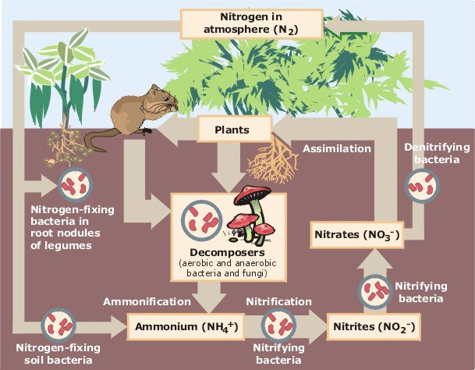
The Nitrogen Cycle: Describes the movement of the element from the air into the biosphere and organic compounds and back into the atmosphere. Synthetically produced nitrates are key ingredients of industrial fertilizers and key pollutants causing the eutrophication of water systems.
⚙️ Industrial Production & Chemical Properties
Industrial Production: Nitrogen gas is produced by the fractional distillation of liquid air or by mechanical means using gaseous air (i.e., pressurized reverse osmosis membrane or pressure swing adsorption). When supplied compressed in cylinders, it is often called OFN (oxygen-free nitrogen).
In a chemical laboratory, it is prepared by treating an aqueous solution of ammonium chloride with sodium nitrite, or through the decomposition of sodium azide:
[latex]NH_4Cl (aq) + NaNO_2 (aq) \rightarrow N_2 (g) + NaCl (aq) + 2 H_2O (l)[/latex]
[latex]2 NaN_3 \rightarrow 2 Na + 3 N_2[/latex]
Chemical Properties: Nitrogen is a nonmetal with an electronegativity of 3.04. It has five electrons in its outer shell and is trivalent in most compounds. The triple bond in molecular nitrogen (N₂) is one of the strongest known.

Spectrum of Nitrogen: Sending an electric current through nitrogen excites the electrons to higher energy levels.
💡 Applications of Nitrogen Gas
- As an inert replacement for air where oxidation is undesirable.
- As a modified atmosphere, pure or mixed with carbon dioxide, to preserve the freshness of packaged or bulk foods.
- In ordinary incandescent light bulbs as an inexpensive alternative to argon.
- In production of electronic parts such as transistors, diodes, and integrated circuits.
- Filling automotive and aircraft tires due to its inertness and lack of moisture or oxidative qualities.
- As a propellant for draft wine, and as an alternative to or in combination with carbon dioxide in carbonated beverages.
Nitrogen is also used in preparing samples for chemical analysis to concentrate and reduce the volume of liquid samples, as well as powering paintball guns under high pressure.
Need High-Purity Compressed or Liquid Nitrogen Supply?
ThanhGas guarantees purity ≥ 99.99%, working pressure ≥ 135 atm, and provides liquid storage tanks and vaporizers on-site for businesses.











 Views Today : 2244
 Total views : 547603
 Who's Online : 4